 Debout RDC La plume pour un Congo debout



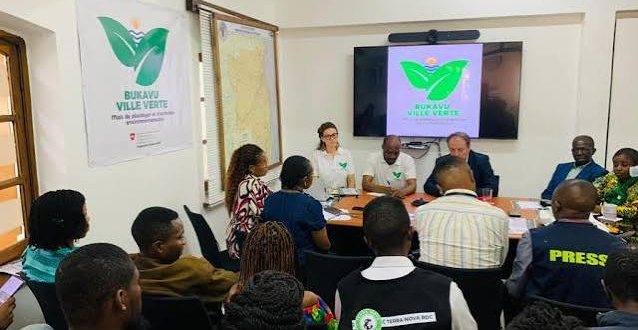
March 2026 was marked by sanitation and greening activities in Bukavu, the capital of South Kivu in the eastern Democratic Republic of the Congo. This city of approximately two million inhabitants produces over 400 tons of solid waste daily. Authorities, civil society, the media, researchers in short, all social strata were mobilized. Trees were planted, flowers and lawns were laid out, and plastic waste was collected, reflecting a massive mobilization. Nearly six months later, the city is back to square one. The trees did not survive, and waste continues to coexist with residents. The Green Month appears to have been a mirage, despite assurances from the authorities. However, for the Swiss Cooperation, which initiated this campaign, the expected results were achieved.
Green Month: A poor remedy for a known disease
From March to August 2026, nearly six months after the Green Month activities, Bukavu has become as dirty as usual, and the long-awaited greening is nowhere to be seen. Despite various initiatives, some residents viewed the Green Month activities as « a good remedy for the wrong disease » entirely missing the mark. The Swiss Cooperation refutes this assertion. Despite « the short duration of the initiative (one month), the expected results were achieved satisfactorily for all stakeholders, » assured André Daniel Müller, Deputy Head of Cooperation at the Swiss Cooperation Office in the DR Congo, in an exclusive interview granted to the Debout and Mkulima press group.
Invisible trees on the sites
Despite the Swiss Cooperation’s assurances, the results remain mixed. In addition to waste management activities, trees were planted at specific sites. On the ground, many trees are virtually gone; others have dried up due to a lack of watering.
« Everyone planted trees using their own methods and species just to make the initiative look nice. We planted on problematic sites without prior study. The Swiss Cooperation should invest in a community nursery that will produce seedlings regularly, » advised Fiacre Kalugusha, an activist with the citizen movement Lutte pour le changement (LUCHA).
On the Elakat hillside and the Wima high school site, known as « Yesu Yesu, » the trees have disappeared.
« Here, on Route 29B, on the Elakat hillside not far from the Ruzizi II border post, houses have replaced seedlings, unfortunately on rugged terrain. Everyone wants to own a home without considering the consequences, » lamented Mr. Aganze, a resident of the Panzi neighborhood in the Ibanda municipality.
The Swiss Cooperation acknowledges that post-planting activities fell short.
« Despite the commitments made by local authorities, the protection of the trees against degradation, as well as the regular watering of seedlings and ornamental trees, were not always effectively ensured by local authority officials, » admitted André Daniel.
The consequences of this abandonment are visible at the Place de la Paix, in the Bagira municipality, and along the CADECO-Radio Maendeleo road stretch. The lawn and flowers have dried up, and the trees are experiencing water stress. Only the metal signs withstand the neglect and the heat of the dry season, while art pieces made from waste remain visible at Place Mulamba and at the 33rd military region in the Ibanda municipality.
Waste management: Back to square one
During this dry season, the situation seems normal to a hurried visitor. There is no flooding towards the Kawa River estuary, and the Kawa canal from Kadutu is calm, albeit foul-smelling. Near ISGEA, bottles are swept from Mukukwe towards Luziba, in the valley below the Ruzizi cemetery and the Saïo military camp. « A true disaster, » complained a resident met on ISGEA Avenue, where the Luziba stream crosses the road leading to Camp Saïo.
Some residents along the Kawa River and Lake Kivu, near the SNCC port, note that young people spend days collecting plastic bottles, but within minutes, it is back to square one.
« Most of these plastic bottles and other refuse come from several places crossed by the Kawa River, from Nyamiera to Kabare, passing through Nyamugo and Industrial Avenue in Bukavu, before emptying into the lake across Independence Square, » explained Léonard Bagalwa, a man in his sixties living on Poste II Avenue along Lake Kivu. He warned that if nothing is done, Bukavu will flood again, and all this garbage will end up in Lake Kivu.
« A few months ago, I saw a group of young people, apparently members of some associations, collecting plastic bottles floating on Lake Kivu. Back then, just as now, there are people who collect plastic bottles to reuse them, » added another local resident.
The same problem is acknowledged by the researchers and scientists who actively took part in the Green Month activities.
« We see piles of garbage dumped here and there, clogged gutters, plastic bottles thrown everywhere, construction on inappropriate sites, erosion, and the encroachment of houses on the Lake Kivu shoreline. In short: the city is highly unsanitary, and its environment continues to degrade, » lamented Pascal Masilya, a university professor and environmental expert, while assessing the city’s sanitation status.
Several social actors acknowledge that the Swiss Cooperation did its part and that it is now up to the community to take over. However, some accuse the SDC of lighting a fire and then stopping the supply of wood.
« The authorities thought these activities would be sustainable, local organizations hoped for funding, and young entrepreneurs expected to receive small grants for waste recovery, but they were deeply disappointed, » regretted a civil society actor who closely followed the Green Month.
Other actors accuse the SDC of choosing to work with its traditional partners, the majority of whom lack significant experience in the sanitation sector.
« The proof is that before the Green Month equals after the Green Month, » deplored Fiacre Kalugusha, a LUCHA activist.
For the Swiss Cooperation, however, this momentum led to the creation of a sector stakeholder platform and the emergence of a new synergy among waste collectors. The organization regrets that, a few months later, a municipal authority decision granting a citywide waste collection monopoly to a single company compromised this dynamic.
The Mayor of Bukavu acknowledges that several recommendations were made. « Recommendations were formulated. Unfortunately, at this stage, there are no concrete actions resulting from these recommendations. I myself spoke of the need to create a circular economy, to support organizations through loans, grants, allocations, and subsidies to enable an economy to build around the recycling, removal, and treatment of waste. We are not there yet, but I believe this is just a beginning, a process, » reassured the city’s mayor, Nicolas Kyalangalilwa.
The cost of inaction
Unresolved environmental issues severely impact not only the residents’ quality of life but also public health in Bukavu. Deogratias Cubaka, head of the TERRANOVA organization, warned about the cost of inaction and advocated for citizen mobilization to make Bukavu a green city: « For the population, it is a matter of understanding that inaction carries a heavy price and that everyone has a role to play in protecting the environment by adopting ecological habits ».
« Apparently, our population has not yet fully grasped the benefits of living in a healthy environment. However, we hope that with continued awareness-raising and environmental education, changes will occur, » advised Madeleine Bwenge, head of the organization Action for Environmental Education, Gender, and Sustainable Development in Kivu.
« A city without sanitation and without a waste management plan, where all waste is dumped into the lake, exposes its citizens to serious health risks and the spread of diseases and epidemics, » recalled André Daniel.
Unity in adversity
In the spirit of the Swiss Cooperation, the Green Month was an awareness initiative aimed at informing all strata of the population about the effects of pollution and encouraging collective reflection on potential solutions. The activities demonstrated that if different stakeholders work together, solutions can emerge.
« I think this ownership was only fleeting, but it remains possible if the authority implements coercive measures so that the population makes the recommendations of this campaign a priority, » lamented Professor Masilya, alluding to the weak community ownership.
He added:
« The population must know that it is the primary author of the city’s insalubrity and also the first victim of this situation. Therefore, it must begin sanitizing the city without waiting to be forced by anyone. To the authority, I reiterate that it must make the fight against insalubrity its battle horse and use all the means at its disposal to lead the population and partners to make the city clean ».
Green Month: It wasn’t all dark
This campaign left a mark and raised awareness among a significant portion of the population, primarily school-aged youth, regarding Bukavu’s unsanitary conditions.
« This campaign brought about some progress, such as the reforestation of certain erosion-prone sites (Elakat, the slope of the Bagira Institute…), the greening of certain road axes, and the collection of bottles…. However, in the absence of follow-up and implementation of the recommendations submitted to the provincial authority, it is clear that the situation will continue to worsen, and the few efforts made will merely be overshadowed, » acknowledged Masilya.
« I must acknowledge the work the Green Month accomplished. This month helped us in terms of education, which is an ongoing task. It is hard to believe that one month would be enough to educate and change mentalities, but it is a start, » added Mayor Nicolas Kyalangalilwa.
Following the Green Month, several waste recovery or recycling initiatives are developing. The innovative ideas fair opened the eyes of many young people.
« The Green Month campaign was one of the initiatives carried out to maintain Bukavu’s environmental balance. Everyone should seize this opportunity to continue the good practice of eco-friendly actions. The population must now concern itself with the preservation of its environment instead of remaining passive, » advised Madeleine Bwenge.
For the Swiss Cooperation, the Green Month was a success in terms of awareness-raising. « The Green Month was, above all, a one-off awareness and mobilization initiative, not a magic formula to solve all problems overnight, » recalled André Daniel. The current challenge is to capitalize on this momentum through coordinated follow-up among authorities, researchers, and civil society.
A media role under fire
During the Green Month, the media component played an important role in raising awareness. Articles, public broadcasts, videos, and infographics were widely distributed.
« The media played a highly crucial role. Today, nearly six months later, several messages continue to be rebroadcast thanks to the radio programs developed. Other media outlets have even created shows dedicated to the environment, » rejoiced Deogratias Cubaka.
However, media attention quickly shifted to other emergencies. For Fiacre Kalugusha, « practically, the only thing that worked was the communication, which was more propaganda than real information ».
What should be done?
Faced with the challenge of systemic insalubrity, experts recommend integrating environmental education from a very young age.
« Environmental education must begin in primary school to teach sorting from an early age. Authorities must set up landfills in every neighborhood. We must understand that these activities serve to save the human species, not to fill conferences with no conclusive results, » warned Fiacre Kalugusha.
The State is also called upon to guarantee the right to a healthy environment, enshrined in Article 53 of the Constitution. Professor Masilya points out that after the campaign, « much remains to be done ». For its part, the mayor’s office claims to be reorganizing waste collection: « We have given a new rhythm and a new approach to sanitation. The Elakat site is no longer a dump, and we are reorganizing the removal according to a precise schedule that the population must respect, » maintained Mayor Nicolas Kyalangalilwa.
Innovations for sustainability
To sustain waste management, private and civil society actors propose incentive-based economic models.
« We need a financial model where contributions produce value and motivate households to sort, » advocated Fiacre Kalugusha. It is with this in mind that the start-up Young Web Africa designed the BukavuGreen app. « It allows residents to collect their waste and receive points convertible into Cash Power top-ups, mobile data, or food items, » explained its director, Trésor Mushagalusa.
For its part, the EKAGRI agency proposes a results-oriented approach. « Our firm has implemented a results-based management model. If a student dormitory manager or a neighborhood correctly manages its sorting system, they receive a financial or material reward at the end of the month, » detailed Emmanuel Kitumaini, an expert at EKAGRI.
The Swiss Cooperation did its part
The lights of the Green Month went out during the closing ceremony at Alfajiri College. Thomas Jenatsch, Director of the SDC, drew a positive assessment there, recalling the planting of over 20,000 trees at strategic sites such as the Wima High School, Elakat, and Bagira. « We have done our part, » he concluded. More than six months later, in the absence of a formal follow-up mechanism for the recommendations, Bukavu views the Green Month « as a fleeting mirage, a flash in the pan that burns high before dying out seconds later, » lamented a resident met in the Bagira municipality.